Feeling overwhelmed by your finances and unsure how to make them work? I’ve been there too. With monthly expenses piling up—from groceries to school fees to household bills—it’s easy to feel pulled in a hundred directions and not know which to tackle first.
These smart money rules aren’t strict laws you have to follow perfectly. They’re simple, time-tested guidelines that bring structure, clarity, and a sense of calm to your financial life. They help you grow what you have, prepare for the unexpected, and make everyday decisions with more intention. Whether you’re a mom managing the household budget, balancing work with family needs, or getting back on track after a setback, these finance rules can gently guide you forward.
Ready to take control of your finances? Here are smart money rules to help you build stability, make thoughtful choices, and shape a future where your money flows with purpose and supports the life you truly want.

10 Smart Money Rules
Table of Contents
1. Rule of 72 ( The Double Your Money Rule)
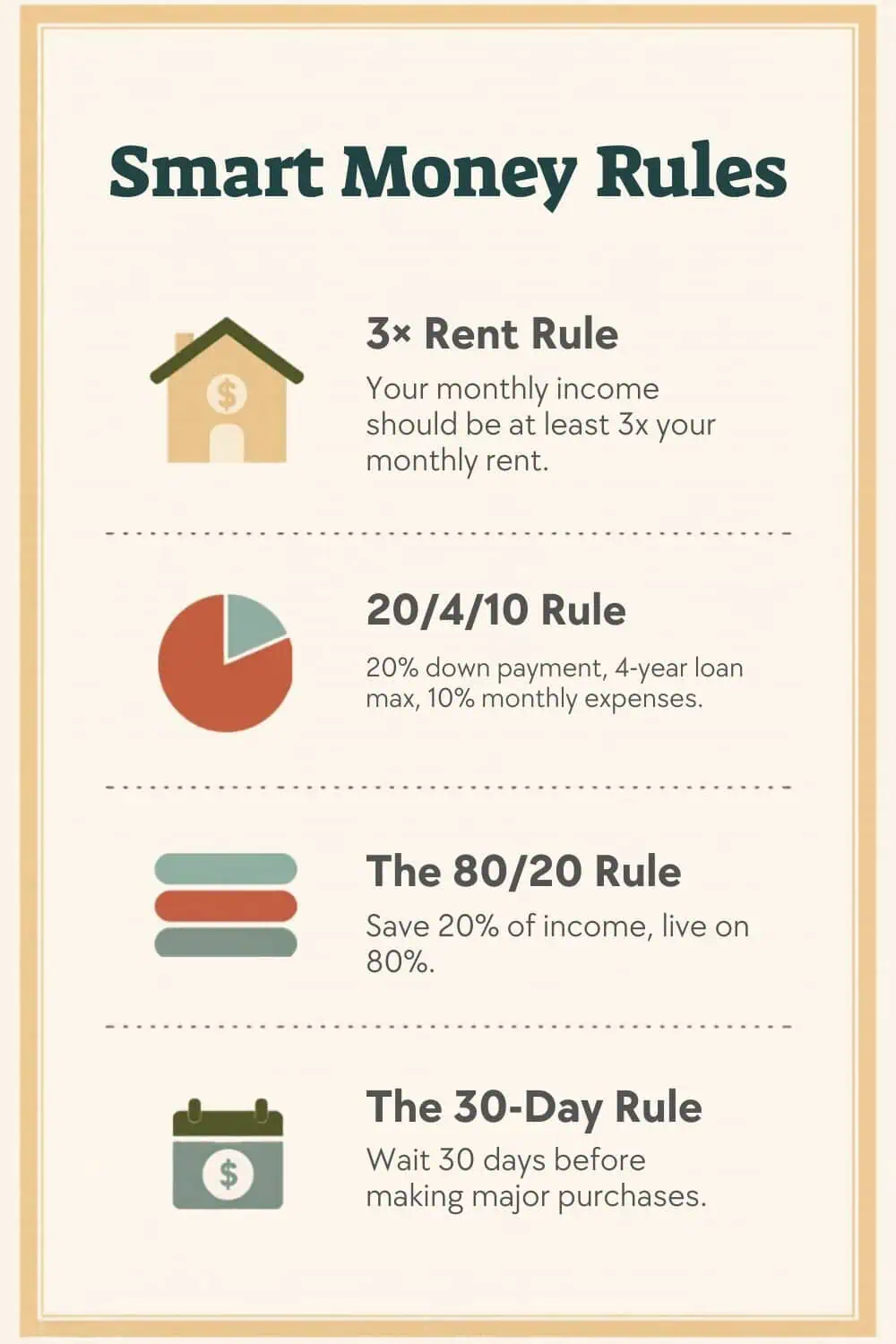
The Rule of 72 guides you to find out how long it will take for your money to double. It’s a simple finance rule that helps you estimate the growth of your savings or investments without complicated calculations.
How It Works
Take 72 and divide it by the interest or growth rate of your investment. The result shows roughly how many years it will take for your money to double.
Example: If you put $5,000 into an account that grows at 8% a year:
72÷8 = 9 years to double
This means your $5,000 could grow to about $10,000 in 9 years, if growth rate stays steady.
The Rule of 72 works best for investments or savings that grow at a predictable rate. Plan ahead, contribute consistently, and treat the result as a guide—not a guaranteed prediction.
2. 2× Investing Rule
The 2× Investing Rule encourages you to balance spending and saving—for every amount you spend on a non-essential item, invest an equal amount. This approach let’s you enjoy your purchases without guilt while steadily growing your wealth.
How It Works
Choose a non-essential purchase, then put the same amount into an investment or savings account.
Example: If you spend $300 on a gadget, invest $300 at the same time to keep your finances balanced.
To stick to this rule, track your extra purchases and stay consistent with your investing habit. Set up an automatic transfer to your account after each purchase—this makes building your savings effortless and stress-free.
3. The 50/30/20 Budget Rule
This rule suggests splitting your income into three main categories--half to essentials, a third to personal wants, and the rest to savings and investments. Following this rule helps you balance your spending while gradually building long-term financial security.
How It Works
Start by calculating your total income and assign each portion as follows:
- Essentials (50%) – covers bills, groceries, and other necessary expenses
- Personal Wants (30%) -- for dining out, hobbies, or small indulgences
- Savings and investments (20%) – money set aside to grow your finances, such as building an emergency fund, contributing to retirement, or saving for short-term goals
Example:
If your monthly income is $2,000, your budget could look like this:
- $1,000 (50%) – essentials
- $600 (30%) – wants
- $400 (20%) – savings or investments
Using the 50/30/20 rule helps you feel in control of your money while still enjoying life. Small adjustments, like choosing cost-effective options or hunting for hunting for deals can help you stick to this rule without feeling restricted.
Related Reading: How to Use the 50/30/20 Budget Rule ( Free Printable!)
4. The Emergency Fund Rule
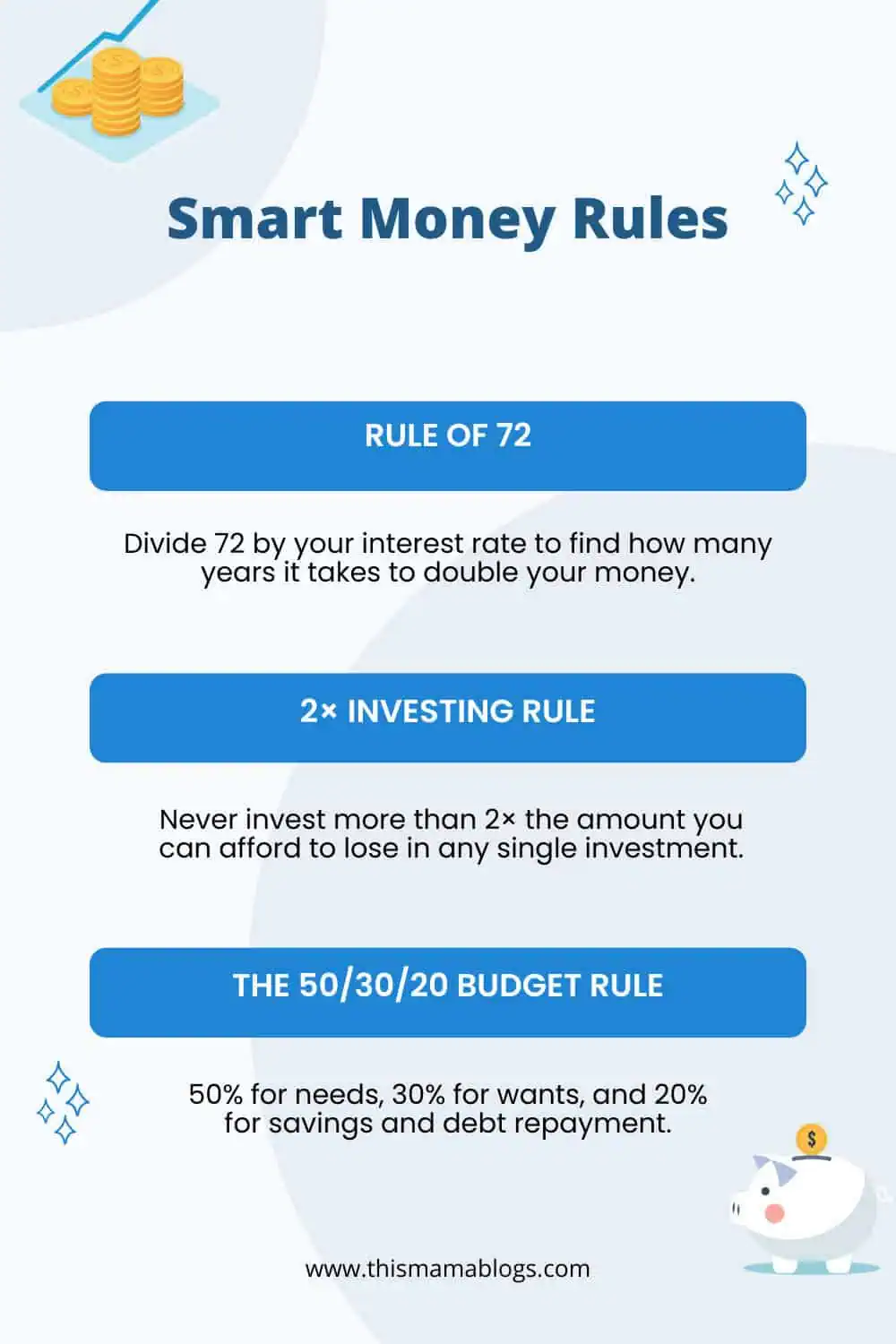
A key rule for financial security is to keep an emergency fund that can cover 3 to 6 months of your living expenses in a safe, easy-to-access account. This fund gives you a buffer, so you can handle unexpected costs—like car repairs, medical bills, or sudden changes in income—without having to rely on credit or tap into your long-term savings.
How It Works
- Calculate your essential monthly expenses—rent, groceries, utilities, and transportation.
- Multiply that number by 3 to 6, depending on how much security you want.
- Build the fund gradually by setting aside a small amount each month until you reach your goal.
Example: Let’s say your monthly expenses total $2,000—here’s how your emergency fund could add up:
- 3 months of expenses: $2,000 × 3 = $6,000
- 6 months of expenses: $2,000 × 6 = $12,000
You could start by setting aside $200 each month. Over time, this steady saving builds up to create a full 3-6 month emergency cushion.
Survey shows only 47% of Americans could cover a $1,000 emergency using their own savings, highlighting the importance of having an emergency fund. Make sure you add to it regularly so it’s ready when unexpected costs come up.
5. The 4% Retirement Rule
The 4% rule says you can withdraw 4% of your retirement savings each year, so you can cover your needs while making your savings last through retirement.
How It Works
Calculate your total retirement savings and multiply that amount by 4% to see how much you can spend each year. This gives you a simple guideline to plan your yearly retirement budget.
Example: If you have $500,000 saved for retirement, $500,000 x 4% = $20,000. You could spend around $20,000 per year without risking your savings running out too soon.
Keeping your withdrawals at a steady rate like 4% allows your savings to keep growing while covering your yearly expenses over time. Make sure you stay flexible and adjust your spending when needed, especially during market changes, so your plan stays on track.
6. The 40% Debt Rule
The 40% debt rule sets limits on your total debt payments—including mortgages, loans, and credit cards—keeping them at or below 40% of your monthly income. Staying within this range helps keep your finances manageable and gives you room to cover other priorities.
How It Works
To follow the 40% debt rule, it helps to break the process into clear steps:
- Add all your monthly debt payments, including mortgages, loans, and credit cards.
- Calculate 40% of your take-home pay—this is the maximum you should spend on debt each month.
- Compare your total debt payments to this limit.
- If your payments exceed the limit, find ways to reduce high-interest balances or adjust your repayment plan to stay within the recommended range.
Example: If your monthly income is $3,000, 40% of that is $1,200. This means all your monthly debt payments combined should ideally stay at or below $1,200.
This rule helps you maintain control of your finances while leaving room to grow your savings or investments. Make sure to review your debts regularly and tackle high-interest balances first to avoid falling behind.
7. 3× Rent Rule
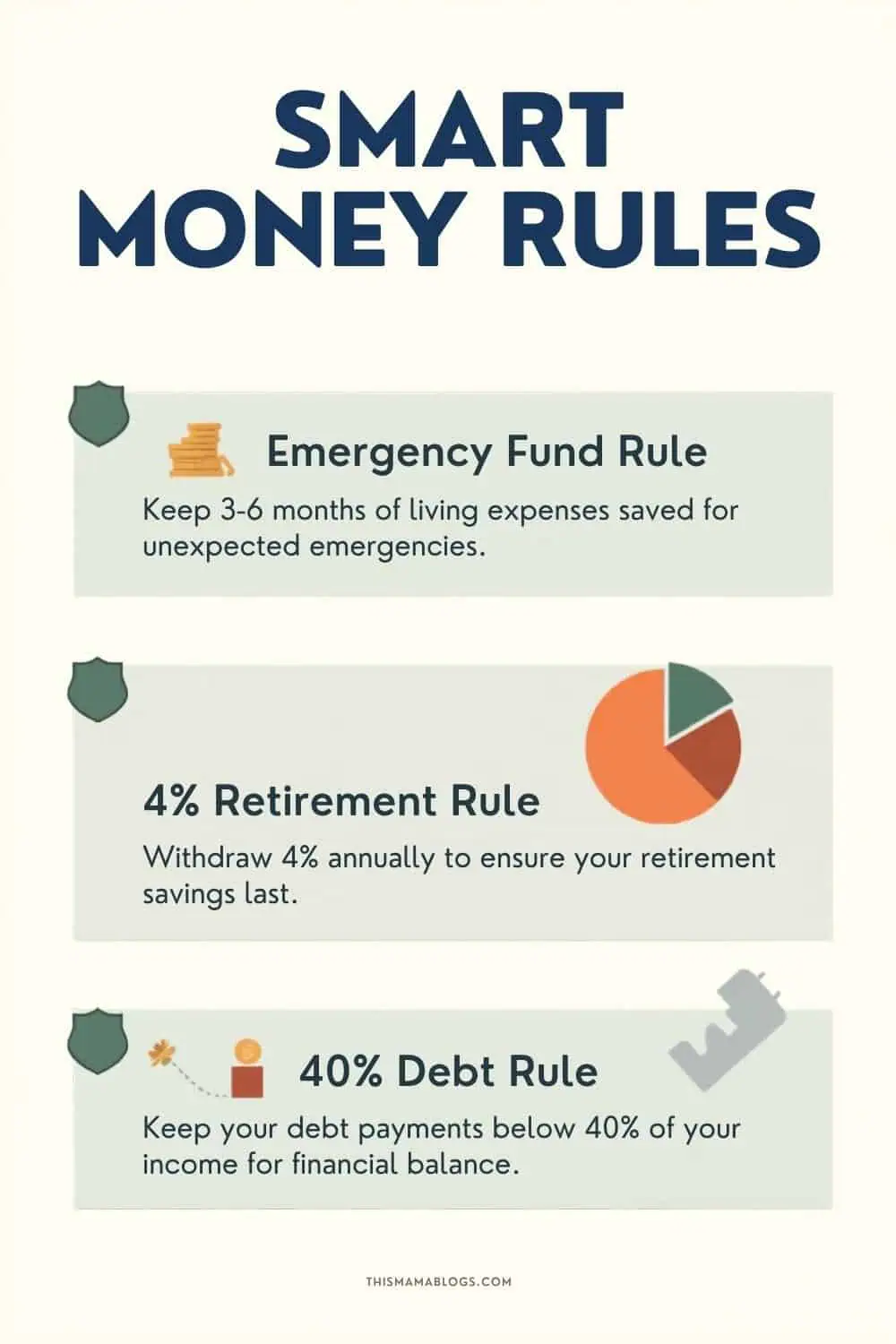
The 3× rent rule offers a practical benchmark for housing costs. If you're renting, your monthly income should be at least 3x your monthly rent. Thus, it suggests keeping your monthly rent at around one-third of your gross monthly income so you don’t overstretch your budget to housing alone.
How It Works
Start by identifying your gross monthly income before taxes. To estimate a manageable rent, divide your income by 3—this gives the maximum amount you should ideally spend on rent each month.
Alternatively, if you already know the monthly rent amount, multiply that figure by 3 to see the minimum income most landlords typically expect.
Example: If your monthly income is $2,500, dividing it by 3 gives you about $833. This means your rent is best kept around or below this amount each month.
Research on rent-to-income ratios suggests that spending more than about 30% of income on rent can lead to financial strain. Carefully checking that your rent fits this benchmark helps you see how much you can afford without crowding out other areas of your budget.
8. 20/4/10 Rule
Taking out a car loan can get costly if you don’t plan carefully. The 20/4/10 helps structure your loan—how much you borrow, for how long, and what you pay monthly—so it stays manageable and fits your income.
How It Works
Use this guideline to keep car costs within what you can afford:
- 20% —Pay at least 20% upfront to reduce loan amount.
- 4-year loan term – Limit your loan term to no more than four years.
- 10% monthly costs—Keep your total monthly car expenses—including loan payment, insurance, gas, and maintenance—within 10% of your income.
Example: Suppose you earn $4,000 a month and are looking at a $30,000 car:
- Down payment (20%): $30,000 × 30% = $6,000
- Loan amount: $30,000 - $6,000 = $24,000
- Monthly car cost limit (10%): $4,000 × 10% = $400
Put $6,000 down, finance $24,000 over 4 years, and keep your total monthly car costs at or below $400.
Following this rule helps you avoid taking on more debt than you can comfortably handle. Compare several car options and choose the one that fits both your finances and priorities.
9. The 80/20 Rule (Pay Yourself First)
This rule recommends setting aside at least 20% of your after-tax income for savings, debt repayment, or investments first, and using the remaining 80% for living expenses and personal spending. By paying yourself first, you build steady savings and avoid living paycheck-to-paycheck.
How It Works
Figure out your take-home pay, which is the amount you receive after taxes and deductions. Then divide it into two parts:
- 20% — put this portion into savings, investments, or to pay off debt.
- 80% — use this portion for your regular living expenses, like bills, groceries, and transportation, as well as any spending for things you want.
Example: If your monthly take-home pay is $5,000, here’s how it breaks down:
- 20% (savings, debt, or investments)
$5,000 × 20% = $1,000
- 80% (expenses and personal spending)
$5,000 × 80% = $4,000
Set aside $1,000 first for savings and debt, then use the remaining $4,000 to cover your monthly essentials and day-to-day spending.
You can use this rule if you want to prioritize saving, manage your money better, or focus on financial goals without tracking every expense. To stay consistent, treat the 80% as your spending limit and adjust your lifestyle to fit within it rather than dipping into your savings.
10. The 30-Day Rule
This rule encourages you to wait 30 days before making any non-essential purchase above a certain amount, like $100. This pause helps you avoid impulse spending and gives you time to decide if the purchase is truly necessary.
How It Works
Set a price limit for non-essential purchases, then wait 30 days before buying. After the waiting period, decide if you still need or want the item.
Example: You see a pair of shoes worth $120 and want to buy them. Since it exceeds your $100 limit, wait 30 days before making the purchase.
After 30 days, you may find that you no longer want the shoes or would rather use the money for something more important. If you still decide to buy them, you can be confident it's a thoughtful decision rather than an impulse.
This rule gives you time to consider what you truly need, helping you avoid wasteful spending. To make it work, weigh the long-term worth of each item—ask yourself how it fits with your financial goals before deciding.
Looking for More Money Tips?
Feel free to browse around for more money or budget tips!




Final Thoughts
Think of these 10 rules of money as your personal financial advice guide—not to restrict you, but to give your decisions direction and clarity. When I put these rules into practice, my financial habits became steadier and more intentional, helping me focus on what matters most to me.
These smart money rules act as a guide to spending and planning, making it easier to work toward your financial goals and build a more disciplined relationship with money. By treating them as a compass rather than a wall, you can make thoughtful choices, enjoy greater financial freedom, and live day to day with peace of mind.